
.jpg)
The US and Australia have jointly tested vehicle-mounted ground-penetrating radar (GPR) equipment on different soil types.
The GPR equipment, which has been used by the Australian Defence Force (ADF) to detect improvised explosive devices (IED) for several years, is now said to require an upgrade to its signal processing component.
Go deeper with GlobalData


Discover B2B Marketing That Performs
Combine business intelligence and editorial excellence to reach engaged professionals across 36 leading media platforms.
Using GPR for IED detection involves challenges caused by the localised variation in terrain and climate, as well as the variety of IEDs encountered.
Countries using the GPRs aim to combine the strengths of mature IED detection technologies such as radars to improve detection probability and reduce false alarms.
Australian Department of Defence researcher Canicious Abeynayake said: “Defence’s areas of operation change from time to time, so we need to have algorithms that are robust enough to work well with different soil types.”
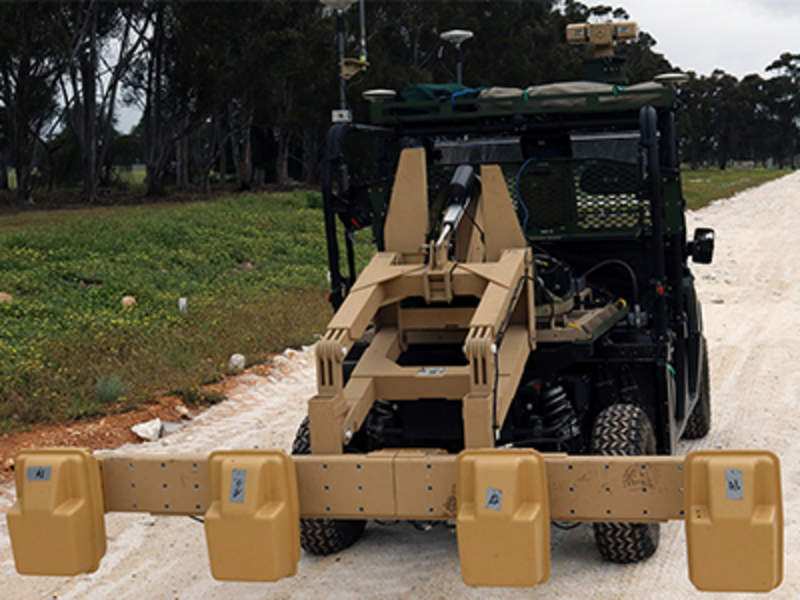
During the six-week long trial, GPR-equipped Polaris and Husky vehicles from the US and ADF were tested on lanes of Australian soil containing objects designed to represent IEDs.
Data gathered from testing will be used to assess improvements to the GPR system’s processing algorithms.
A team from the Defence Science and Technology (DST) will investigate algorithms at the lowest level in order to find out which components are underperforming in different soils and against different targets.
The signal processing algorithms play a key role in transforming signals into meaningful information for operators.
Image: The Polaris vehicle and sensor. Photo: courtesy of Commonwealth of Australia.


