

Aptima has been contracted to support the Agile Teams (A-Teams) programme for the US Defense Advanced Research and Planning Agency (DARPA).
The programme seeks to create a systematic methodology to design teams that combine humans and machines in many work environments, including the military, through the provision of warfighters, drones, robots, and autonomous systems.
Go deeper with GlobalData


Discover B2B Marketing That Performs
Combine business intelligence and editorial excellence to reach engaged professionals across 36 leading media platforms.
Under the $3.5m contract, the company and its partners are developing a framework to represent, test, optimise, and train complex socio-technical systems that are capable of peer-level interaction, mutual learning and problem-solving.
Work under the contract is being supported by Massachusetts Institute of Technology (MIT) professor Julie Shah, University of Connecticut professor Krishna Pattipati, and US-based Sophia Speira.
Aptima CEO and principal founder Daniel Serfaty said: “The goal is to create organisations that are more dynamically responsive, that can quickly adapt to changing situations, and reallocate the right abilities, tasking, and workload across complex, mixed human-machine systems.”
The A-Teams programme aims to discover, test and demonstrate mathematical abstractions for the design of agile human-machine teams, as well as provide predictive insights into team performance.
The programme will use experimental testbeds in order to support reproducible evaluation of human-machine team architectures in a diverse range of problem contexts.
Serfaty added: “Humans are good at collaborating and learning from each other. While current machines are not, the promise of artificial intelligence (AI) is challenging this assumption.
“Much like a high performing sports team uses different plays and players to anticipate and counter what an opponent might do, similarly human-machine systems must be able to collaboratively adapt as mission demands change.”
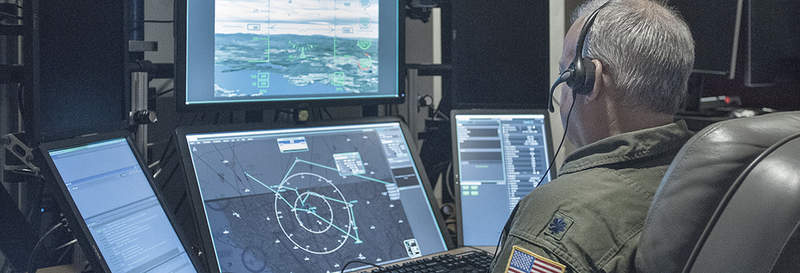
Image: The A-Teams programme seeks to bring together both humans and machines in many work environments. Photo: courtesy of the Defense Advanced Research Projects Agency.


