

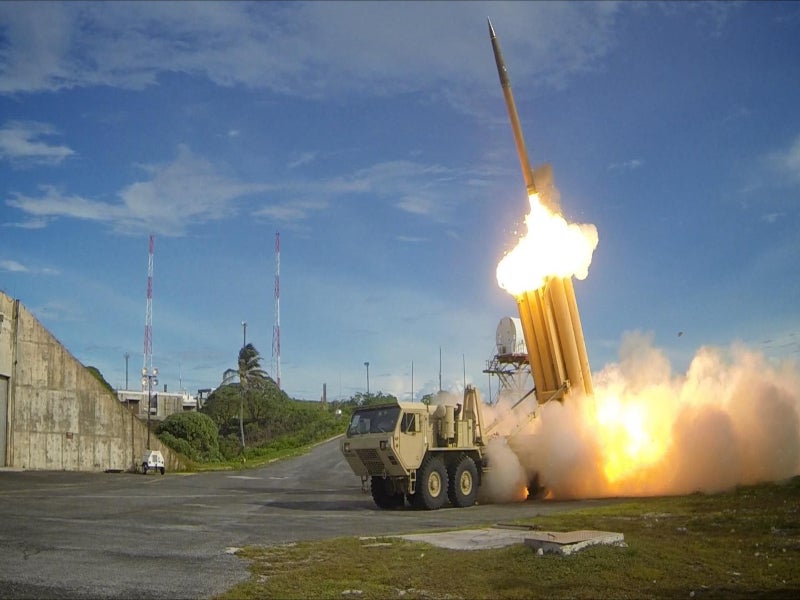
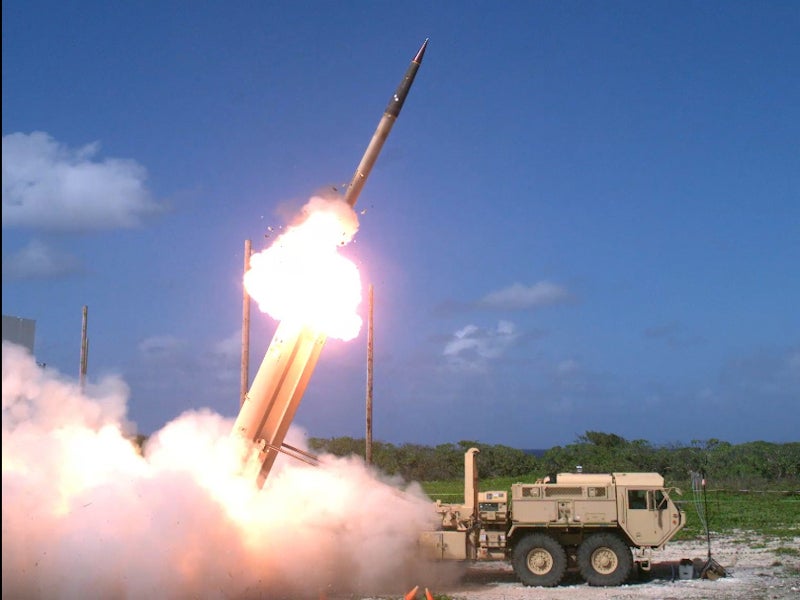
The Terminal high-altitude area defence or THAAD (previously Theatre high altitude area defence) missile system is an easily transportable defensive weapon system to protect against hostile incoming threats such as tactical and theatre ballistic missiles at ranges of 200km and altitudes of up to 150km.
The THAAD system provides the upper tier of a ‘layered defensive shield’ to protect high-value strategic or tactical sites such as airfields or population centres. It intercepts exo-atmospheric and endo-atmospheric threats.
Recommended White Papers
Recommended Buyers Guides
The sites are also protected with lower and medium-tier defensive shield systems such as the Patriot PAC-3, which intercepts hostile incoming missiles at 20–100-times lower altitudes.
THAAD usage in Operation Epic Fury
The THAAD missile system is being used in the ongoing military operation named Operation Epic Fury launched by the US and Israel against Iran.
US Central Command released several videos on how the THAAD system was intercepting Iranian missiles.
There are seven active US batteries, two in the United Arab Emirates (UAE), and one in South Korea, which is being redeployed to the Middle East, according to media reports.
In January 2026, Lockheed signed a framework agreement with the Department of War to raise annual THAAD interceptor output from 96 to 400 amid the ongoing Iran-Middle East crisis.
Subsequently, Lockheed entered into a performance-based agreement with the state of Alabama in March 2026 to support operations at its manufacturing site in Pike County. The arrangement is expected to support customers as demand for munitions output increases.
The Pike County site produces and maintains hardware for major weapons and missile programmes including the THAAD system, and the Javelin and HELLFIRE missiles, as well as the AGM-158 Joint Air-to-Surface Standoff Missile and the Long Range Anti-Ship Missile.
THAAD air defence missile programme
Development of THAAD began in 1992 when Lockheed Martin Missiles and Space and industry partners received a $689m contract to develop a missile defence system.
Raytheon was selected to deliver the ground-based radar, including solid-state receiver and transmitter modules, while Thompson Ramo Wooldridge led software development. Additional radar work went to Raytheon (travelling wave tubes), Datatape (data recorders) and EBCO (radar turrets).
The programme entered the engineering and manufacturing development (EMD) phase in 2000. In May 2004, Lockheed Martin started producing 16 flight-test missiles at its facility in Pike County, Alabama.
Testing on the EMD configuration began in 2005 at White Sands Missile Range, New Mexico, followed by the first full-system flight test (missile, launcher, radar and fire control) in May 2006.
Further testing started at the Pacific Missile Range, Kauai, Hawaii, in January 2007, achieving intercepts including exo-atmospheric.
The US Army activated its first THAAD battery at Fort Bliss, Texas, in May 2008, with a second in October 2009.
THAAD engaged a medium-range ballistic missile in October 2012; another flight test occurred in September 2013.
Pacific Scientific Energetic Materials Company (PSEMC) developed the laser-initiated ordnance system. Alfalight received a $3.7m PSEMC laser contract in September 2014.
In August 2019, the Missile Defense Agency (MDA) tested remote launch. In March 2022, PAC-3 MSE was further integrated into THAAD, enabling earlier launch and an extended flight profile.
The THAAD system has maintained a 100% success rate over its last 16 intercept tests since the beginning of production.
THAAD missile battery
The THAAD battery typically operates nine launch vehicles, each carrying eight missiles, with two mobile tactical operations centres (TOCs) and a ground-based radar (GBR).
THAAD missile information
The target object data and the predicted intercept point are downloaded to the missile prior to launch. The updated target and intercept data are also transmitted to the missile in flight.
The missile is 6.17m (20.24ft) in length and equipped with a single stage solid fuel rocket motor with thrust vectoring. The rocket motor is supplied by Pratt & Whitney Rocketdyne. The launch weight is 900kg.
A separation motor is installed at the interstage at the forward end of the booster section. The separation motor assists in the separation of the kinetic kill vehicle (KKV) and the spent boost motor.
The shroud separates from the KKV before impact. The KKV is equipped with a liquid-fuelled divert and attitude control system developed by Pratt & Whitney Rocketdyne for the terminal manoeuvring towards the target intercept point.
A gimbal-mounted infrared seeker module in the nose section provides terminal homing to close in on the target missile in the terminal phase of approach.
During the initial fly-out phase of flight, the seeker window is covered with a two-piece clamshell protection shroud. Metal bladders installed in the shroud are inflated to eject the protective shroud before the seeker initiates target acquisition.
The infrared seeker head, developed by BAe Systems, is an indium antimonide staring focal plane array operating in the mid-infrared three micrometre (μm)–5μm wavelength band.
M1075 truck-mounted launcher
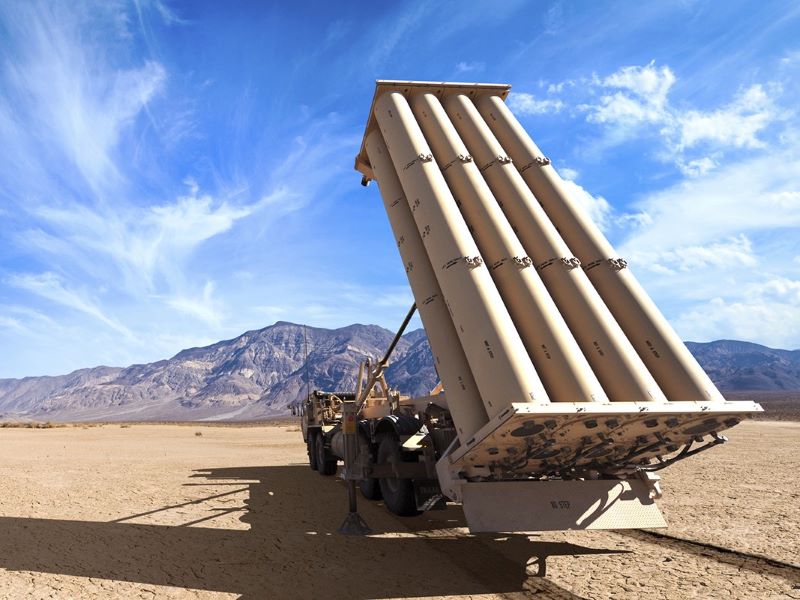
There are nine M1075 truck-mounted launchers in a typical THAAD battery. The launch vehicle is a modified Oshkosh Truck Corporation heavy expanded mobility tactical truck with a load-handling system.
The 12m-long × 3.25m-wide launch vehicle carries ten missile launch containers. While on the launcher, lead-acid batteries provide the primary power. The batteries are recharged with a low-noise generator.
After firing, reloading the launch vehicle takes 30 minutes.
Ground-based radar
The cueing for the THAAD system is provided by the Raytheon Systems AN/TPY-2 GBR for surveillance, threat classification and threat identification. THAAD can also be cued by military surveillance satellites such as Brilliant Eyes.
The ground-based radar units are C-130 air transportable. The AN/TPY-2 radar uses a 9.2m² aperture full field of view antenna phased array operating at I and J bands (X band) and containing 25,344 solid-state microwave transmit and receive modules. The radar can acquire missile threats at ranges of up to 1,000km.
The MDA awarded a $2.3bn production contract to Raytheon for seven gallium nitride-based AN/TPY-2 radars as a THAAD system component in June 2020.
Tactical operations centre
Each THAAD battery has two tactical operations centres (TOC). The TOC has been developed by Northrop Grumman, formerly Litton Data Systems Division. The TOC accommodates two operator stations and is equipped with three Hewlett-Packard HP-735 data processors.
Mobile BMC3I units
The THAAD system can ‘hand over’ targets to other defence systems and can cue the targets to other weapons. It can interface to other US or allied air defence data information networks and to the battle management and command control and communications centre.
Northrop Grumman was contracted to develop the THAAD battle management and command, control, computers and intelligence (BMC3I) units, which are installed in hardened shelters mounted on high-mobility multi-wheeled vehicles.
The THAAD communications system can use a joint tactical information distribution system, mobile subscriber equipment, a single channel ground and airborne radio system and the joint tactical terminal for voice and data communications and for intelligence data transfer.
Orders and deliveries
In January 2007, Lockheed Martin received a contract for the first two production THAAD systems: six launchers, 48 missiles, two radars and two tactical operations centres.
In September 2008, the UAE requested three THAAD fire units, 147 missiles, four THAAD radars, six fire control stations and nine launchers.
In 2011, the UAE finalised a $1.96bn (Dhr7.19bn) agreement for two THAAD weapon systems and associated support equipment, marking the system’s first foreign military sale (FMS). In the same year, Lockheed was awarded a $789.8m contract to provide THAAD weapon systems to the MDA.
The US Army awarded Lockheed Martin contracts for the third and fourth THAAD battery units in 2010 and 2011, with the fifth battery contract awarded in late 2012.
Lockheed also received a $66m follow-on contract in March 2012 for continued THAAD development, and a $150m contract in August 2012 covering 12 launchers, two fire control and communications units, plus support equipment.
In September 2013, Lockheed won a $3.9bn US Army contract to manufacture and deliver up to 110 interceptors, also covering interceptors and ground hardware for the UAE. The MDA placed further orders: $124.6m (October 2014) for ground components; $528m (January 2016) for interceptors; and $459m (January 2018) for interceptor development.
The MDA awarded a $1.47bn contract to supply THAAD interceptor support equipment for the FMS programme supporting the Kingdom of Saudi Arabia (KSA) in July 2019.
A modification contract worth $932m was awarded in March 2020, and another modification contract worth $1.42bn was awarded in March 2022 to supply THAAD interceptor support equipment to the US and KSA.
The MDA placed further orders for THAAD interceptor support equipment valued at $304.9m (April 2022), $180.36m (April 2023) and $2.06bn (July 2025).
In February 2025, the MDA issued an indefinite delivery, indefinite quantity follow-on development contract for five years, with options up to ten.
In June 2025, Lockheed delivered the Minimum Engagement Package for the eighth THAAD battery (three launchers and a fire control unit) for integration with Raytheon Technologies’ AN/TPY-2 radar; remaining components were due later that summer.
In July 2025, the Saudi Royal Air Defence Force unveiled the first THAAD unit, which is part of the country’s efforts to bolster its defence capabilities.
The 900th THAAD interceptor was delivered to the MDA in January 2026
