

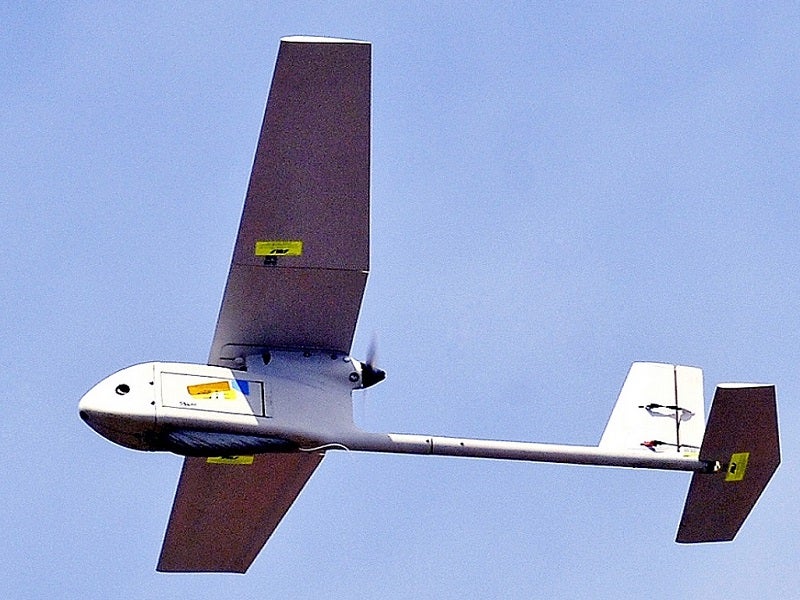
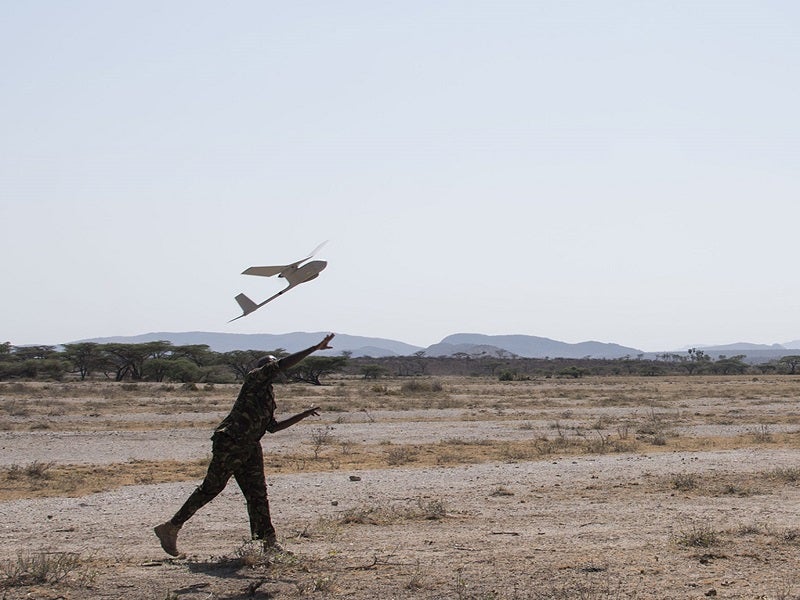
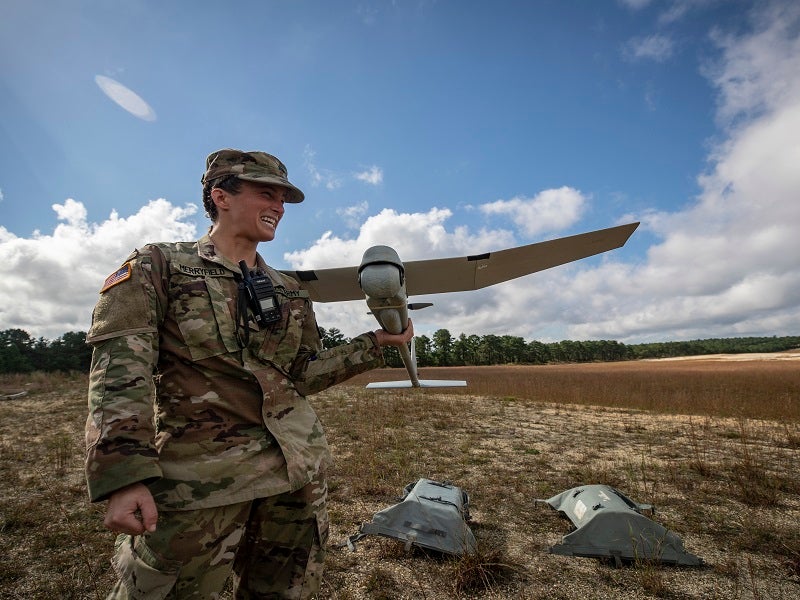
The RQ-11 Raven is a lightweight unmanned aircraft system (UAS) designed for rapid deployment and high-mobility in military and commercial operations. Manufactured by American defence contractor AeroVironment, the tactical UAS meets army requirements for low-altitude reconnaissance, surveillance, and target acquisition. It can be operated manually or programmed for autonomous operation, utilising the system’s advanced avionics and GPS navigation.
Each Raven costs around $35,000 but the total system is valued at approximately $250,000. The US Army, Air Force, Marine Corps and Special Operations Command are the primary users of Raven B. The Raven is also operated by US allies such as Australia, Italy, Denmark, the UK, and Spain.
Recommended White Papers
Recommended Buyers Guides
Raven UAV development
The US Army required live-coverage capability to enable the troops to get real-time, up-to-date and over-the-horizon views in trouble areas. The army bought four AeroVironment FQM-151 Pointer UAVs in 1999 for military operations in urban terrain (MOUT) and the advanced concept technology demonstration (ACTD) programme.
Subsequently, AeroVironment developed a smaller air vehicle called Raven. At half the size of Pointer, it was named the ‘Flashlight’ SUAV (small UAV). It flew for the first time in October 2001.
The Flashlight SUAV was developed into Raven in 2002, as part of the army’s Pathfinder ACTD programme. As it was hand-built, mass production was not possible. Block I of Raven’s modified version, delivered in May 2003, became the first LRIP (low-rate initial production) version.
Block I’s shortcomings, such as difficult launch procedure and insufficient flight stability, were corrected in block II, which was first delivered to the army in September 2003. The batch II
version was tested in Afghanistan. Subsequently, US Special Operations Command ordered a batch of 179 Raven systems with three UAVs each. Batch II was officially designated as an RQ-11A Raven air vehicle.
RQ-11A and RQ-11B Raven UAV variants
RQ-11 UAVs are manufactured in two variants of RQ-11A and RQ-11B, which are designed and manufactured by AeroVironment.
More than 3,000 RQ-11As were produced before 2006. The RQ-11A Raven UAV weighs about 1.9kg (4.2lb). It has a flight endurance of 80 minutes and an effective operational radius of about 10km (6.2 miles). Raven has a flying speed of 32km/h to 81km/h at a typical operating altitude between 30m and 152m. The Raven UAS with the Mantis 123 gimballed sensor has an endurance of 60 to 90 minutes.
RQ-11A Raven provides flexibility, with remote control or control through the ground station. It allows completely autonomous missions using GPS waypoint navigation. CCD colour video and an infra-red camera constitute the standard mission payloads.
The RQ-11 Raven B system is an enhanced version of the battle-proven Raven A. It is a lightweight system designed for rapid deployment and high mobility for both military and commercial applications. The Raven B is the most advanced small unmanned aircraft system (SUAS) deployed with the US armed forces.
RQ-11B has a wingspan of 1.4m (4.5ft) and a weight of 4.2lb. Launched by hand, Raven provides aerial observation, day or night, at line-of-sight ranges of 10km or more.
It can deliver real-time colour or infra-red imagery to ground control unit (GCU) and remote viewing stations, as well as IR laser illumination of ground targets.
Features of Raven UAS
The RQ-11 Raven allows military units to conduct intelligence, surveillance, and reconnaissance (ISR) over danger zones without committing soldiers. It allows the task force to monitor an area with a less obtrusive presence and live video capabilities during day and night.
Launched in just minutes, by hand, into the air like a model aeroplane, the Raven lands itself by auto-piloting to a near hover. It does not require carefully prepared landing strips. Requiring no elaborate support facilities, the Raven ideally suits forward-deployed units. The automated features and GPS technology make it simple to operate, requiring no specialised skills or in-depth flight training.
It delivers real-time colour or infra-red imagery to the ground control and remote viewing stations via three different cameras attached to the nose of the plane.
One of these is an electro-optical camera placed either on the nose or side, while the second is an infra-red camera in the nose. The third is an IR camera located on the side.
Because of the size of the technology, the IR camera is fairly large and does not have a zoom so it cannot lock onto a target. However, it does have high enough resolution to show whether someone is carrying a weapon.
Ground control unit of AeroVironment RQ-11 Raven
The GCU is a compact and lightweight system, which displays real-time videos and images captured by the vehicle’s payload cameras.
The processing, retrieving and storing of the real-time data provided by the UAV is carried out at the GCU. It can also playback videos for target evaluation and alleviate retransmission of videos and meta data to the operations network.
GCU can be operated as a remote video terminal (RVT) when implanted at remote location. It also allows the command centres to view and analyse the data. The GCU can be easily assembled or disassembled in two minutes.
The range and service ceiling of the aircraft are 10km and 4,500m respectively, while its maximum endurance is 90 minutes.
RQ-11 orders AeroVironment won the small unmanned aerial vehicles (SUAV) programme competition organised by the US Army in October 2005. The winning contract included a supply of 2,182 Raven systems along with the ground control system and three air vehicles. In 2010, the contract was increased to 2,358 Raven systems.
RQ 11B Raven’s full-rate production for the US Army was scheduled up to 2015. The company is required to provide upgrades to ensure continuous system improvements over the life of the programme.
The Royal Danish Army acquired 12 Raven systems in September 2007. Three systems are being used by the Huntsmen Corps. The others are deployed with the Artillery Training Centre. Around 72 Raven B systems were acquired by the Netherlands Ministry of Defence at a cost of $23.74m.
In December 2009, the US Army signed a contract worth $16.75m with AeroVironment for the purchase of 50 new Raven RQ-11B UAS equipped with the company’s Digital Data Link (DDL).
AeroVironment received a $3.6m contract from the US Marine Corps in March 2012 to deliver RQ-11B Raven SUAS and initial spares packages.
In March 2013, the US Army placed a $13.8m contract for RQ-11B Raven systems, new miniature gimbaled payloads and initial spares packages. The US Army also awarded a $15.8m contract in May 2012.
It was followed by a $13.5m contract in August 2013 for the delivery of RQ-11B Raven SUAS and Mantis gimbaled payloads by September 2013.
In October 2013, AeroVironment secured a $20m order from the US Army to provide Mantis i23 gimbaled sensor payloads to upgrade the RQ-11B Raven. An order for the Raven spare parts was placed by the US Army in September 2014.
The US Army placed a $3.4m FMS contract with AeroVironment for the delivery of RQ-11B Raven UAVs to the Spanish Ministry of Defence in August 2015. It also awarded an $18.5m foreign military sales (FMS) contract to AeroVironment for the supply of RQ-11B unmanned aircraft systems, spare parts and logistic services to seven partner countries in October 2015.
The Portuguese Army placed a $5.9m order for 12 Raven unmanned systems in 2018. The first RQ-11B Raven UAVs were delivered to the Portuguese Army in June 2019.
In June 2019, the US Army signed a $55m contract with AeroVironment to modify the radio frequency of its existing Raven B unmanned vehicles fleet. An initial contract option to modify the radio frequencies of the US Army’s existing Raven fleet was awarded in July 2020, which was followed by the second contract option in March 2021.
AeroVironment received a $6.4m contract from an existing defence customer from Southeast Asia to deliver additional Raven UAVs in September 2019.
