

Iron Dome is the world’s most used multi-mission air defence missile system, developed by Rafael Advanced Defence Systems, a state-owned defence technology company in Israel.
The system was deployed by the Israeli Air Force (IAF) in March 2011. The all-weather air defence system protects the population and critical assets and can be strategically placed to reduce collateral damage.
Recommended Buyers Guides

Iron Dome detects, analyses and intercepts a range of incoming threats including air-breathing threats, artillery, counter-rocket, cruise missiles, dense salvos, mortar (C-RAM), precise guided missiles (PGM) and unmanned aerial vehicles.
Iron Dome deployment in Iran-Middle East crisis
The Iron Dome air defence system has been actively intercepting incoming aerial threats in the ongoing Operation Epic Fury and Operation Roaring Lion, a joint operation launched by the US and Israel against Iran in February 2026.
According to media reports, Iron Dome has been largely successful in intercepting the aerial attacks launched by Iran against Israel, although some Iranian missiles, such as the Khorramshahr-4, Fattah and Kheibar ballistic missiles, have been able to evade the system and cause casualties in some parts of Israel.
Iron Dome air defence system background and development details
The Israeli Defence Ministry launched the development of the Iron Dome mobile air defence system in February 2007 to counter the rocket attacks it had experienced in preceding years from Lebanon and Gaza.
The missile defence system was successfully tested in March 2009. The testing was carried out without physically intercepting a missile or rocket. In July 2009, during a defence ministry test, the system successfully intercepted a number of rockets.
A new battalion was established by the IAF in August 2009 to operate the Iron Dome system. Multiple rocket bombardments mimicking Qassams and Katyushas were intercepted successfully in a test carried out in January 2010.
Final testing of Iron Dome was undertaken in July 2010. The system successfully determined and intercepted only incoming missile threats, while other missiles, which were headed toward open fields, were not intercepted.
Iron Dome defence missile system details
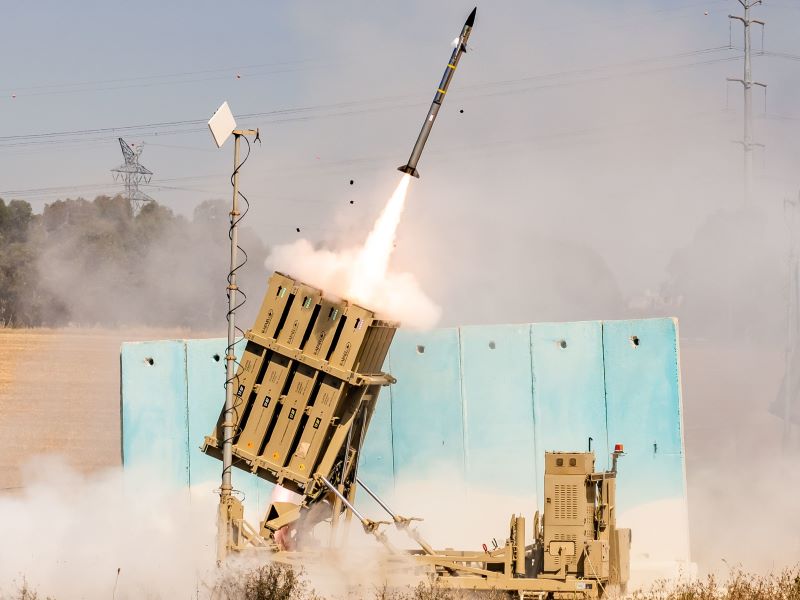
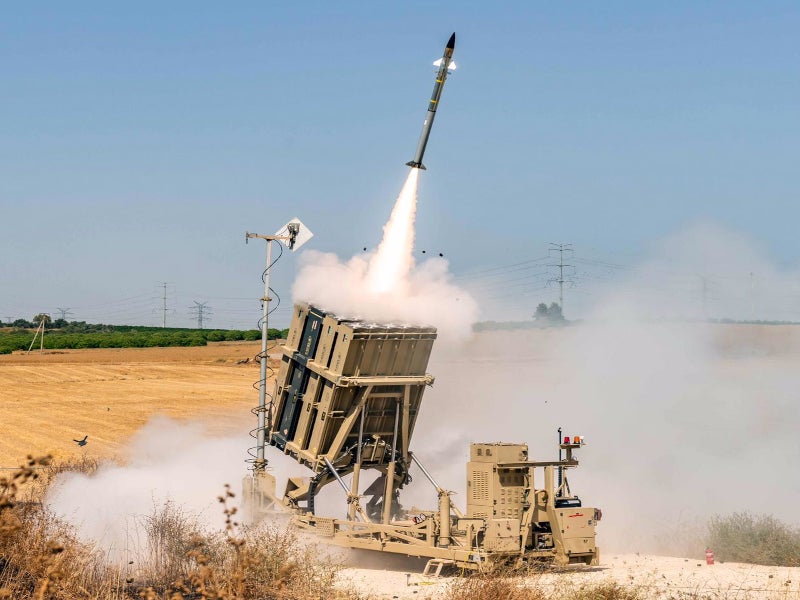
Iron Dome contains three fundamental elements: a battlefield radar, which locates incoming missiles, a Battle Management and Weapon Control (BMC) system, which processes the data transmitted from the radar, and a missile firing unit (MFU), which launches a faster missile to intercept the incoming missile at a higher altitude.
Iron Dome’s radar demonstrates its effectiveness within a range spanning 2.5–43.5 miles (4–70km).
The MFU is a first-of-its-kind multi-mission launcher designed to fire diverse interceptor missiles such as Tamir, which can intercept incoming threats launched from distances ranging between 4km and 70km. The missiles feature electro-optic sensors and several steering fins for high manoeuvrability with proximity fuse blast warheads.
After detecting and identifying the rocket, Iron Dome radar monitors its path. Based on the radar’s information, the system’s BMC analyses the path of the threat and calculates an anticipated point of impact.
If the calculated path of the incoming rocket poses a real threat, a command is run to launch an interceptor against the threat. The incoming rocket is detonated over a neutral area.
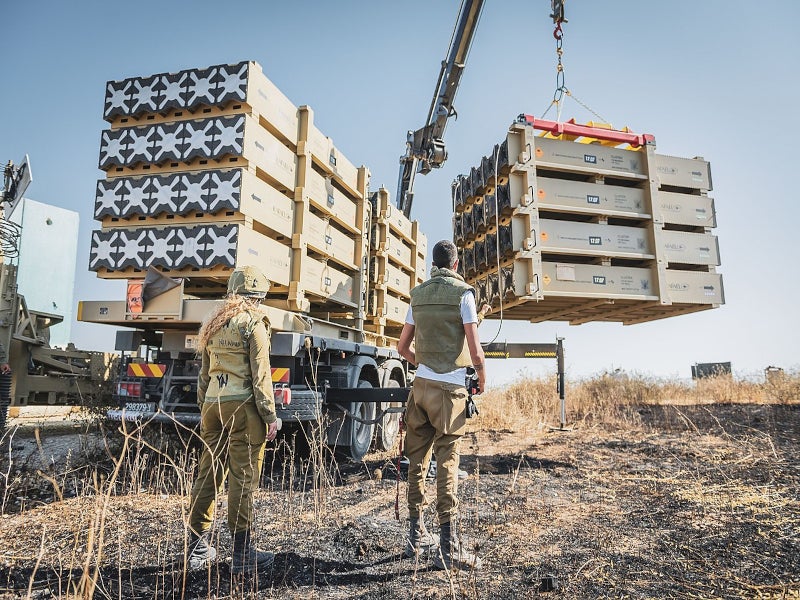
Each battery of Iron Dome contains three to four stationary MFUs, 20 Tamir missiles and a battlefield radar. A single battery can safeguard an area of almost 60 square miles (155.4km2) by intercepting any threats targeting densely populated regions.
The missile system’s open architecture design permits seamless integration with an integrated battle command system and other elements utilised within the indirect fire protection capability framework, including its radar systems.
Iron Dome missile system features
The missile system was developed to counter very short-range rockets and 155mm artillery shell threats with ranges of up to 70km. It has day-and-night and all-weather capability, quick reaction time and salvo interception capability.
The system can also adapt to rapidly evolving threats and handle multiple complex threats at the same time. It can operate as a stand-alone system or as a layer in a multi-layer air defence system.
Other features of Iron Dome include a vertical launch interceptor, warhead and proximity fuse, mobile launcher, and compatibility with various radar and detection systems. The system’s special warhead allows it to detonate any target in the air.
The system has a reputation for intercepting more than 5,000 incoming targets with a more than 90% success rate.
Upgrades and tests
Israel performed a series of live-fire drills of a multi-layered air defence system using the Iron Dome, David’s Sling and Arrow weapon systems in December 2020.
The technological upgrade of the system to simultaneously shoot down multiple complex threats was tested in a series of three tests, of which the latest test was performed in southern Israel in March 2021.
Iron Dome successfully intercepted and destroyed targets that simulated existing and emerging threats.
In March 2025, the Israel Missile Defence Organisation (IMDO) at the Directorate of Defence Research & Development within Israel’s Ministry of Defence (IMOD), working with Rafael Advanced Defense Systems, carried out a series of interception trials for Iron Dome against a range of advanced threats and operational scenarios.
Drawing on experience gained during the conflict with Hamas, the trials assessed how the system performs in simulated current and emerging threat environments, including attacks involving rockets, cruise missiles and unmanned aerial vehicles (UAVs). The programme also tested further components intended to strengthen the resilience of Israel’s multi-layered air defence network.
During the Gaza conflict, Iron Dome was deployed extensively to counter a large volume of incoming threats, helping to protect civilians and critical infrastructure. The latest trials demonstrated updated capabilities designed to improve performance against evolving regional risks.
Orders and deliveries
Raytheon collaborated with Rafael for the commercialisation of the Iron Dome weapon system in the US in August 2011. Raytheon secured a $149m (NIS462.39m) contract from Rafael for the supply of Tamir interceptor components used in the system in September 2014.
In August 2019, an agreement was signed between IMOD and the US Defense Department, facilitating the acquisition of two Iron Dome batteries for the US Army. The first battery was delivered in September 2020, while the delivery of the second battery was completed in January 2021.
Raytheon Rafael Area Protection Systems was formed as a new joint venture between Raytheon and Rafael in August 2020 to establish an Iron Dome production facility in the US.
The US Congress approved an $8.7bn support package in April 2024, including $5.2bn earmarked for strengthening Israel’s air and missile defence capabilities across Iron Dome, David’s Sling and the Laser Defence System.
The deal was concluded after negotiations involving the IMDO, the US Missile Defence Agency, the ministry’s finance team and Rafael. Under the agreement, Rafael is expected to supply additional Iron Dome interceptors for the ministry and the Israel Defense Forces.
In January 2025, IMOD signed an agreement with Rafael to expand production of Iron Dome interceptors with funding from the support package. A procurement order for the Iron Dome interceptors was signed in November 2025.
Other versions of Iron Dome defence system
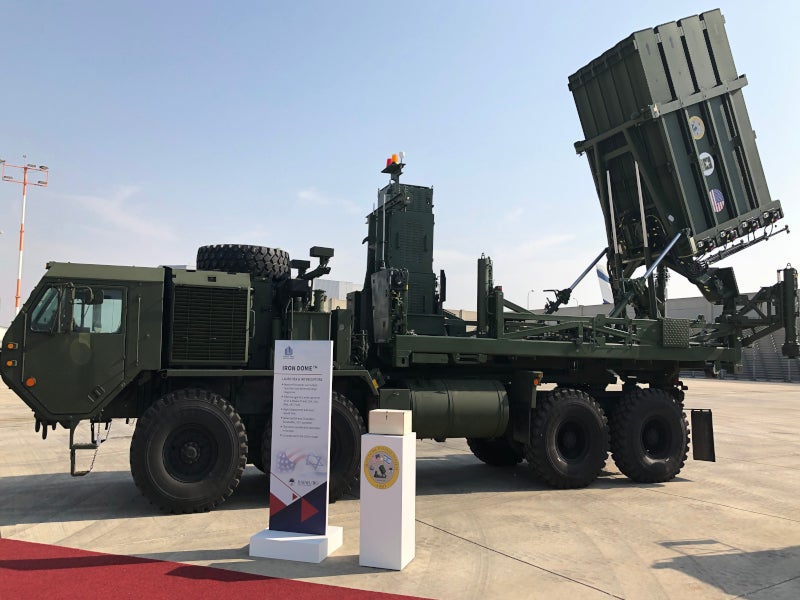
I-DOME is a mobile version of the system, which can be deployed on a single truck. It is a dual-mission, very short-range and C-RAM air defence system. It consists of a wheeled 6×6 chassis launcher with ten Iron Dome interceptors, a radar and a BMC operating station.
C-DOME is a naval version, which was deployed by the Israeli Navy in 2017. The C-DOME system provides 360⁰ hemispheric coverage and can safeguard crucial naval and terrestrial assets from sophisticated ballistic, aerial and surface-to-surface threats, even in scenarios involving saturated attacks.
Contractors involved
The radar system of Iron Dome was developed by Israeli defence company Elta.
Rafael contracted Israeli software company mPrest Systems for the development of Iron Dome’s control system.
