
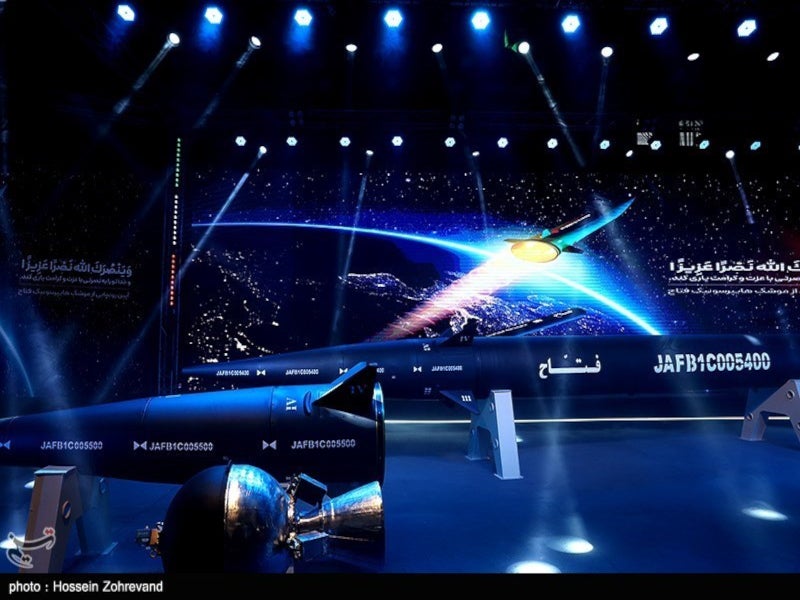
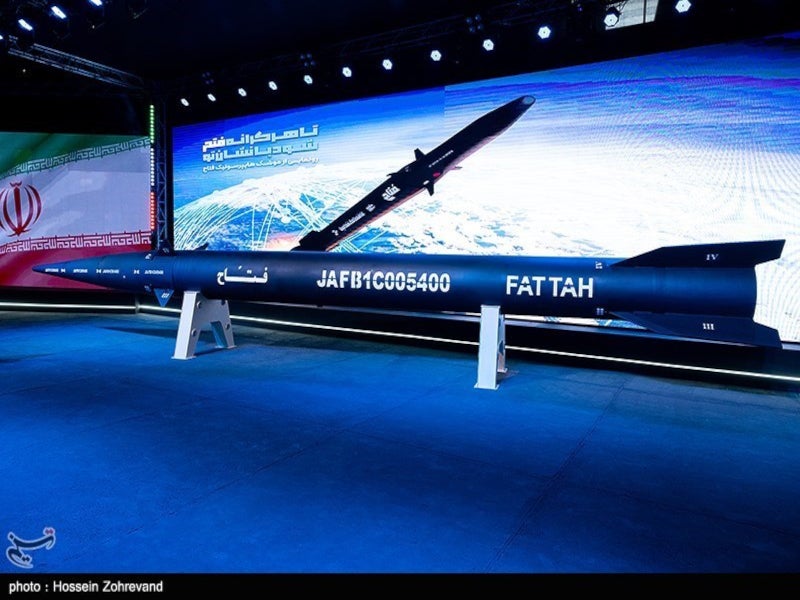
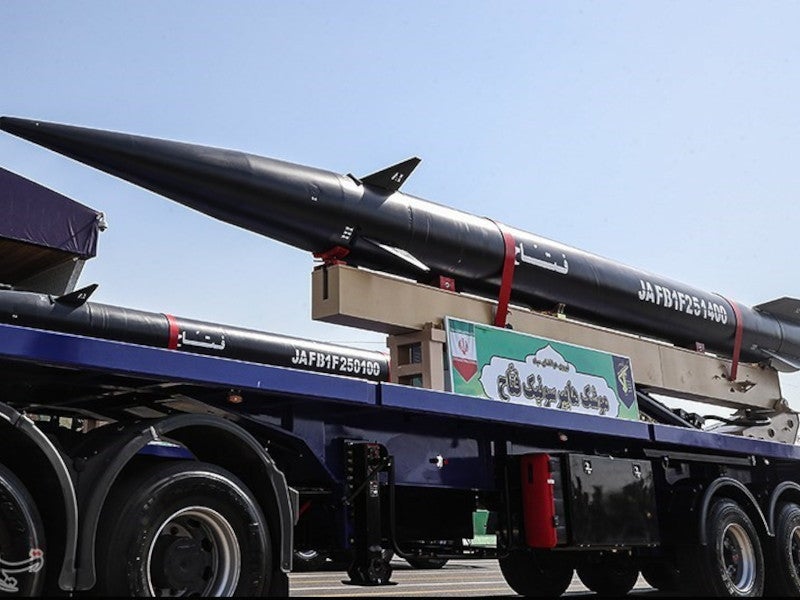
Fattah-1 is a hypersonic ballistic missile developed by the Aerospace Force of the Islamic Revolutionary Guard Corps (IRGC), a multi-service military unit of the Iranian Armed Forces.
Loosely translated as the “victor” in Arabic, the missile was developed to enhance Iran’s deterrent capabilities.
Recommended Buyers Guides

In November 2022, Iran announced the development of a hypersonic missile at an event marking the 11th martyrdom anniversary of Hassan Tehrani Moghaddam, who is known as the father of Iranian missile technology.
The Fattah-1 hypersonic missile was launched in June 2023 after completing further tests. Iran claimed to be the fourth country to possess hypersonic technology.
The US, Russia, China, India and North Korea are other countries that possess operational supersonic intercontinental ballistic missiles.
In November 2023, Iran unveiled the Fattah-2 missile, which features a glide capability.
IRGC deploys Fattah missiles in Iran-Middle East crisis
According to media reports, the IRGC is currently deploying the Fattah-1 and Fattah-2 missiles in Operation True Promise-4, launched in retaliation against the US and Israel.
In February 2026, the US and Israel launched Operation Epic Fury and Operation Roaring Lion, respectively, against Iran to destroy its military infrastructure and prevent it from acquiring nuclear weapons.
Media reports indicate that Iran launched the Fattah missiles in March 2026, targeting US and Israeli military installations and bases in the region.
Fattah-1 missile design details
Fattah-1 is a precision-guided hypersonic ballistic missile capable of penetrating all types of defence shields, including the US and Israel’s most sophisticated anti-ballistic missile systems, such as the Iron Dome employed by Israel.
Hypersonic missiles can achieve speeds at least five times greater than the speed of sound while following intricate flight paths, rendering them highly challenging to intercept. The missile can also evade and bypass radar systems.
The upper atmosphere’s friction generates exceptionally high temperatures while the missile’s high velocity creates a surrounding of superheated particles, hindering the transmission of radio communications.
Performance of the Fattah-1 missile
Fattah-1 can strike a target at a speed between Mach 13 and Mach 15, and has a range of 1,400km (870 miles).
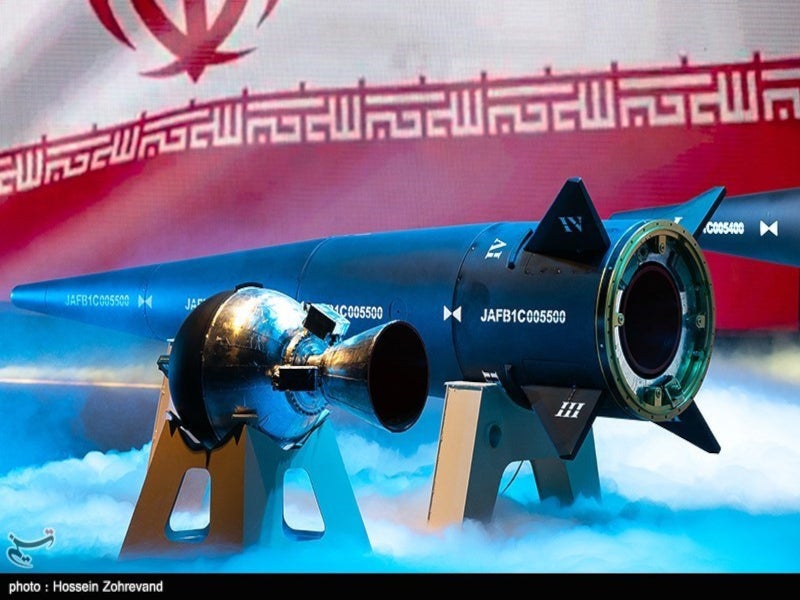
The system features a mobile nozzle, enabling the operator to manipulate the missile’s trajectory and direct it in different directions.
Fattah-1 can also modify its plane of movement in space. It can perform lateral movement to the left and right, up and down, as well as rotate or integrate within the upper atmosphere.
The missile is capable of penetrating sophisticated missile and air defence systems due to its high speed, stealth design and manoeuvrability within and outside the Earth’s atmosphere.
Propulsion of the Fattah-1 missile
The Fattah-1 missile is equipped with an engine, a second-stage movable nozzle, solid fuel propellant, a control guide and a warhead, offering tactical capabilities at extremely high speeds.
The missile gets activated by a spherical propellant within an estimated range of several hundred kilometres from the intended target.
Iran’s ballistic missiles
Prior to the introduction of the Fattah-1 hypersonic missile, Iran had developed a diverse array of ballistic missiles aimed at enhancing its security. Among them are several short-range solid-fuelled ballistic missiles within the Fateh series such as the Fateh-110 and Fateh-313.
The Dezful missile, alternatively referred to as Zolfaghar or Qasem, is an upgraded version of a short-range solid-fuel ballistic missile within the Fateh family, boasting an estimated range of 700km.
The Emad liquid-fuelled ballistic missile marked Iran’s initial steps into long-range missile technology. It is equipped with a new warhead designed for improved accuracy and possesses a range of 1,700km. Both the Emad and Dezful missiles were unveiled in 2016.
The Ghadr-110 (Qadr-110), Fajr-3, Ashoora, Khorramshahr 4 ballistic missile, Sejjil, and Shahab-3 are some of the other missiles developed by Iran to enhance its strategic capabilities.
