
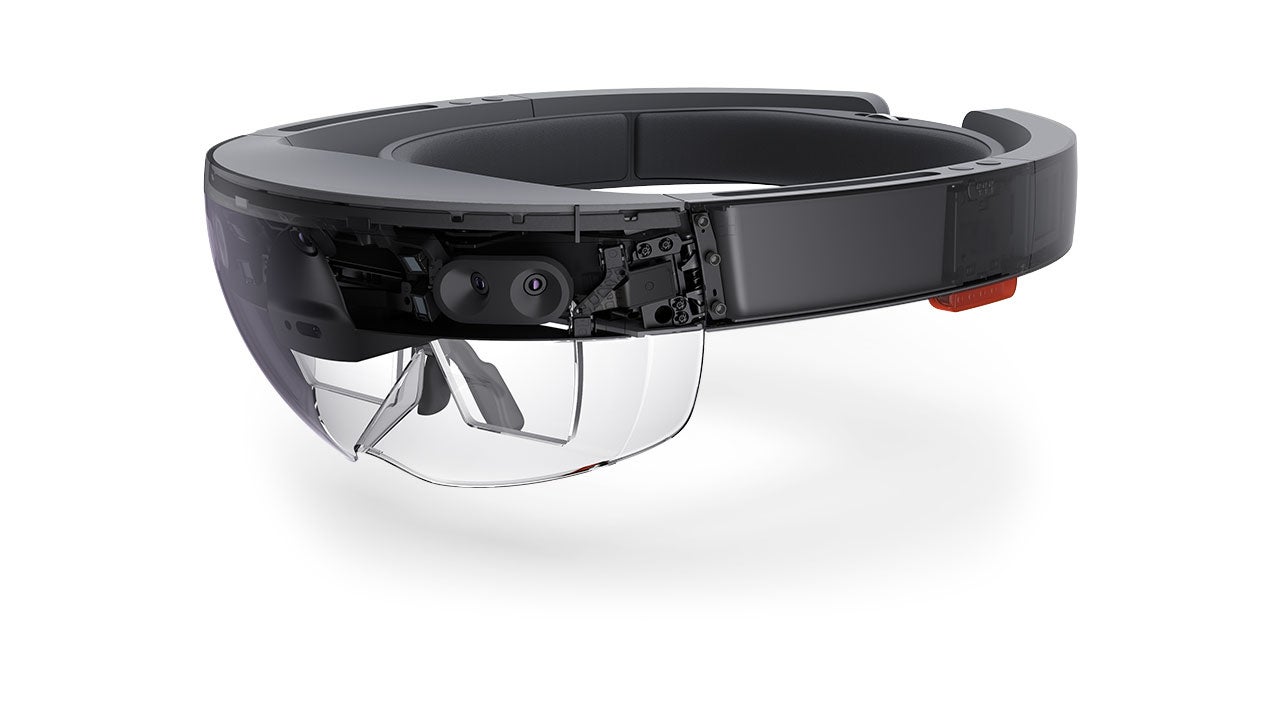
In an announcement dated 31 March, the Army’s Program Executive Office – Soldier (PEO Soldier) announced “a fixed price production agreement to manufacture” IVAS, adding that the award “transitions IVAS to production and rapid fielding”.
Microsoft Technical Fellow Alex Kipman blogged:
Go deeper with GlobalData


Discover B2B Marketing That Performs
Combine business intelligence and editorial excellence to reach engaged professionals across 36 leading media platforms.
We appreciate the partnership with the U.S. Army, and are thankful for their continued trust in transitioning IVAS from rapid prototyping to rapid fielding.
The IVAS adds night-vision and thermal imaging sensors to the usual HoloLens heads-up display, and is ruggedised for military use. Apart from allowing soldiers to see in the dark and in thermal vision, it’s intended to let them easily view and understand information from many sources.
Fellow soldiers’ positions, reported by the GPS systems in their own IVASs, would appear in the heads-up display. So might those of enemies, detected by drones or aircraft overhead, or found by other soldiers. Reportedly it’s possible to project a gunsight pipper onto the IVAS display, showing where a soldier’s weapon is aimed even if he or she isn’t looking along the sights. Naturally the system can be used to call up maps and other useful information.
Other applications could include letting soldiers see through walls, as where they might be sitting in the back of an armoured vehicle but able to simply turn their heads to see what was outside by importing data from the vehicle’s omnidirectional camera systems. Alternatively, troops might have access to 3D city or building maps letting them know what lay ahead before going through a door or round a corner.
Microsoft president Brad Smith has even suggested that IVAS could incorporate facial recognition technology, flagging up database information on people it detected in front of a soldier.
Microsoft has boldly told the AP that IVAS could now be worth “up to” $21.88bn over the next ten years. However only $1.12bn was budgeted for the project in FY2021, and Congress cut that to $897m in December.
A report from the Pentagon’s Director, Operational Test and Evaluation (DOT&E) in January flagged up problems that occurred in 2019 IVAS trials, including inaccurate GPS positions and night-vision and thermal imagery equipment not working. Other Pentagon assessments had previously said that the display screen wasn’t useable in daylight and its light gave away soldiers’ positions at night. However project officials have remained bullish, saying the problems had occurred in earlier, non-militarised versions of IVAS.
Efforts to provide troops with networked displays and devices have been underway for a long time. The US Army’s previous Land Warrior system started out around 1990, morphing through a variety of different configurations and featuring a helmet-mounted monocle display, weapon-mounted camera/sight, chest and arm mounted controls, various data links and GPS equipment.
Versions of Land Warrior went to war in Iraq and Afghanistan with some units, but the project was eventually ended in favour of its successor the Ground Soldier System, later renamed Nett Warrior after Medal of Honor winner Robert Nett. Later versions of Nett Warrior got rid of almost all the Land Warrior hardware and ended up as off-the-shelf commercial smartphones such as the Samsung Galaxy Note 2 hooked up to military Rifleman radios for connectivity. Nett Warrior is still in use with the Army, though it is issued only to team leaders.
If IVAS succeeds it will probably be the saviour of HoloLens. Originally Microsoft, like various other tech firms, had hoped that VR/AR goggles could be sold to gamers, but those hopes are now largely dead. HoloLens 2, the current civilian version, is now pitched more as a work device for surgeons, maintenance engineers and so on.
By Lewis Page, Technology Sector Editor, Verdict.
This article originally appeared on Verdict.



