
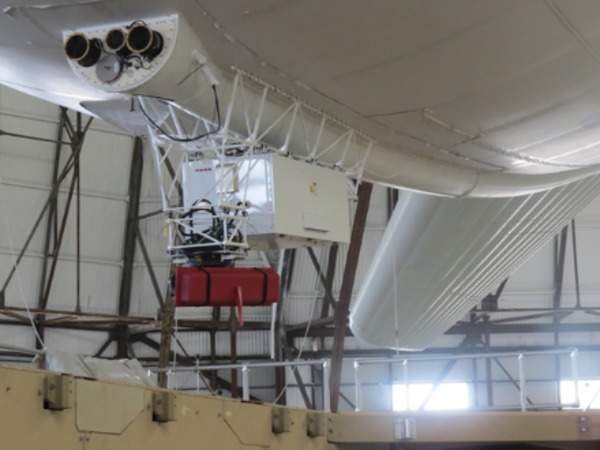
Lockheed Martin has successfully fitted its 74K aerostat aircraft system, an unmanned helium-filled blimp, with RDR-1700B radar developed by Telephonics.
The lightweight and cost-effective RDR-1700B radar is a search surveillance, tracking, imaging and weather avoidance system suitable for use by both manned and unmanned rotary and fixed-wing aircraft.
Go deeper with GlobalData


Discover B2B Marketing That Performs
Combine business intelligence and editorial excellence to reach engaged professionals across 36 leading media platforms.
To be used to conduct land and sea missions, the 74K aerostat system is integrated with a number of multi-mission payloads and high operational availability.
The large helium-filled blimp helps support troops in a range of adverse and challenging environments by providing a multi-mission, multi-domain persistent surveillance capability.
The current installation follows the company’s successful integration of a number of payloads, including radar sensors from Leonardo and Northrop Grumman, in addition to electro-optic / infra-red cameras provided by L-3 Wescam.
Lockheed Martin navigation, surveillance and unmanned systems vice-president Jerry Mamrol said: “The integration of the Telephonics radar showcases our continued commitment to exploring the latest technologies as part of our aerostat systems.
US Tariffs are shifting - will you react or anticipate?
Don’t let policy changes catch you off guard. Stay proactive with real-time data and expert analysis.
By GlobalData“It allows for multi-domain, modular and open architecture capabilities for faster, more cost-effective development efforts.”
Also referred to as a persistent threat detection system (PTDS), Lockheed Martin’s 74K aerostat system provides US soldiers with long-range intelligence, surveillance, reconnaissance and communications assistance.
With more than 1.6 million combat mission flight hours, the aerostat features a robust design, communications relay, as well as command, control, and computer integration, which supports automated interoperability between tactical and theatre surveillance assets.
In addition, the air system supports the distribution of operational threat data in order to facilitate the interception of hostile fires and unconventional threats.



