
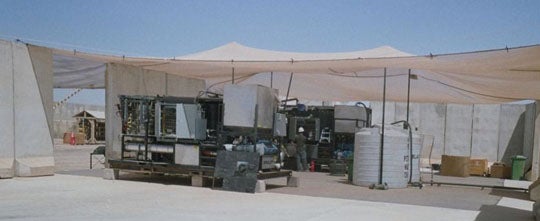
 The US Army Edgewood Chemical Biological Center (ECBC) has signed a cooperative research and development agreement with SAIC to develop the tactical garbage to energy refinery (TGER) 2.0 system for the US Army.
ECBC scientific advisor for biotechnology James Valdes said that the TGER can address all kinds of unnecessary problems encountered during transportation of fuel in and waste out of an operations centre.
Go deeper with GlobalData

Discover B2B Marketing That Performs
Combine business intelligence and editorial excellence to reach engaged professionals across 36 leading media platforms.
"It allows the warfighter to have a clean environment with a readily available energy source," he said. "And it saves the military money and possibly warfighters lives."
The TGER is a bio refinery, trailer-mounted hybrid technology designed to transform a wide variety of military field waste, such as paper, plastic, packaging and food waste into immediately usable source of power at the forward operating bases, battlefield or in a crisis area.
Ethanol and gas are created and fed by the system into a mixture from which electricity is derived, with zero associated CO2 emissions, eventually decreasing diesel usage by more than 95%.
In addition, TGER is able to retrieve and purify water from the liquid waste added to the system.
US Tariffs are shifting - will you react or anticipate?
Don’t let policy changes catch you off guard. Stay proactive with real-time data and expert analysis.
By GlobalDataAside from reducing costs and operational difficulties for waste disposal, the system will also generate important cost savings by lowering the need for acquisition and distribution of fuel through vehicle convoys, which are vulnerable to attack during an overseas crisis deployment.
Two TGER 1.0 system prototypes have already performed well during the three-month operational testing conducted by the army, at 120°C temperatures and sand storms at Camp Victory, Iraq, in 2008.
The real-time field tests enabled the scientists to evaluate the system and subsequently develop an improved TGER 2.0 system.
Apart from military use, the system could also be used during disaster relief efforts and can also provide enough energy to power hospitals and homes during such conditions.
ECBC and SAIC worked in collaboration with the US Army Rapid Equipping Force, Defense Life Sciences and Purdue University to develop the TGER system.
Image: The US Army’s TGER 1.0 system prototype during field testing at Camp Victory in Iraq. Credit: James Jay Valdes, PhD, US Army Edgewood Chemical Biological Center.



