

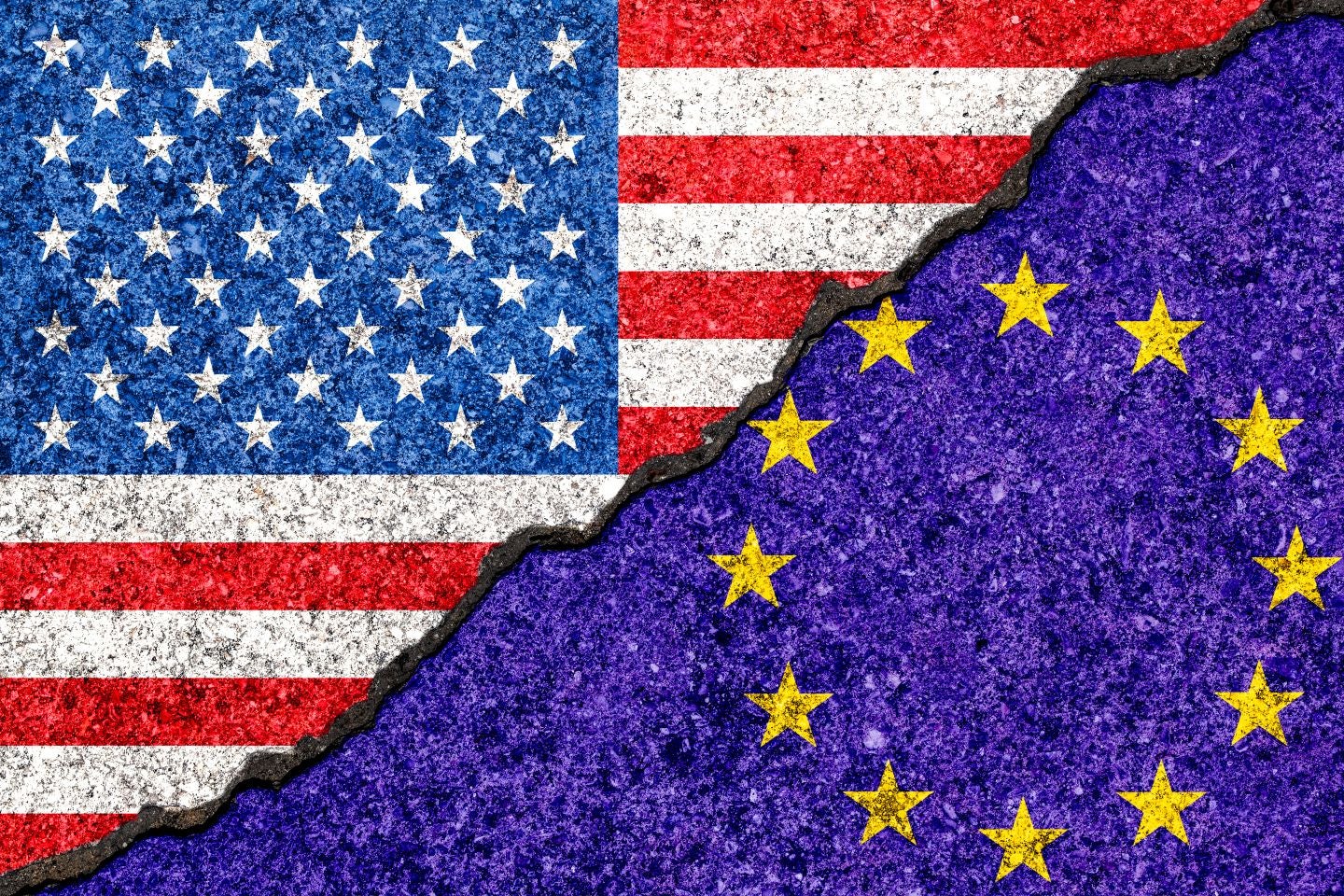
The choice presented to Europe by the 2025 National Security Strategy (NSS) is not between alliance and autonomy, but between subordination without voice and sovereignty without American approval. In attempting to preserve US dominance, the strategy risks dissolving the very alliances that once made that dominance sustainable.
The transactional signals outlined in the 2017 National Security Strategy (NSS) gave way to a fully articulated hierarchy in 2025, in which European sovereignty is conditional on US alignment. Most strikingly, the strategy positions the European Union not as a junior partner in confronting China, but as a distinct and immediate strategic obstacle, something we have seen more recently with Trump’s threats toward Greenland. Rather than treating European capacity as a multiplier of US power, the document treats European agency itself as a source of friction to be contained. As a result, the document casts Europe as a near-term rival whose autonomy, as well as its military and economic might, must be constrained.
Trump’s antics in Greenland didn’t materialise from thin air. His first NSS in 2017 was a profound departure from the status quo established since the end of the Cold War. Typically used to propagate US hegemonic foreign policy under previous presidents, the 2017 US NSS advanced a worldview that systematically undermines European strategic sovereignty and repositions the EU not as a partner but as a competitor, often more explicitly and ideologically than China.
The December 2025 document does not mark a return to realism, nor does it offer a coherent framework for managing great-power competition. Instead, it advances a doctrine of managed dependence. In this framework, sovereignty is no longer measured by formal independence, but by outcome alignment with US priorities.
By positioning the EU as an adversary often more explicitly than China, the strategy fractures the transatlantic relationship at its core. It replaces partnership with discipline, cooperation with hierarchy, and shared strategy with enforced alignment.
Go deeper with GlobalData


Access deeper industry intelligence
Experience unmatched clarity with a single platform that combines unique data, AI, and human expertise.
What is in the document?
The 2025 NSS abandons any pretence that alliances are based on shared authorship of security. Instead, it advances a doctrine of strategic discipline, under which allies are expected to align unconditionally with US priorities across defence, trade, technology, and diplomacy.
The Trump administration helpfully provides bullet points after every segment in the document to outline their key strategies for US national security. In regards to Europe, the TLDR is that the US wants to reestablish “strategic stability within Europe” and stability with Russia, enable Europe to take primary responsibility for its own defense (without being “dominated by any adversarial power”), alter the course of Europe’s current trajectory, open EU markets to US goods, end the perception of Nato as an expanding alliance, and encourage Europe to take action to “combat mercantilist overcapacity, technological theft, cyber espionage, and other hostile economic practices”—clearly a reference to China. Taken together, these objectives reveal not burden-sharing, but boundary-setting: Europe may act, but only within parameters defined in Washington.
European sovereignty is implicitly reframed as a problem to be managed. Independent EU initiatives are treated as deviations from acceptable alignment. Unlike previous US strategies that feared European weakness, the 2025 NSS treats European initiative itself as destabilising. Phrases like “Cultivating resistance to Europe’s current trajectory within European nations” and “Should present trends continue, the continent will be unrecognisable in 20 years or less” clearly show that the Trump administration aims to alter the course of Europe’s future to suit their vision.
Whether you believe that Europe has fallen or not, this change in language from previous presidents and the 2017 NSS should be concerning to Brussels. This marks a fundamental inversion of transatlantic logic: Europe is no longer criticised for doing too little, but for attempting to decide independently.
The US seemingly views the EU as an economic adversary
The most consequential shift in the 2025 NSS is its treatment of economic power. The strategy explicitly fuses national security with US industrial dominance, supply-chain control, and regulatory sovereignty.
Economic policy is no longer adjacent to security; it is the terrain on which loyalty is measured. Within this framework, the EU emerges as a primary antagonist, often described in more concrete and immediate terms than China in this document.
China is framed as an external system-builder whose challenge is long-term and structural. The EU, by contrast, is depicted as a sophisticated competitor operating within the Western economic space, using regulation, standards, and market access to constrain US firms and influence global norms. European competition policy, digital governance, climate standards, and data protection regimes are portrayed not as sovereign choices but as hostile instruments of economic warfare.
Weaponised loyalty and conditional sovereignty
The 2025 NSS introduces a more explicit concept of conditional partnership. Security guarantees, intelligence cooperation, and market access are implicitly tied to demonstrable political loyalty. Formal sovereignty remains intact, but substantive autonomy becomes contingent.
This logic directly undermines the EU’s foundational principle of pooled sovereignty. Multilateral decision-making, consensus-based diplomacy, and rule-based governance are reframed as inefficiencies, or worse, as mechanisms that dilute American power. The document repeatedly contrasts US “decisiveness” with European “proceduralism,” implicitly casting EU governance itself as a strategic liability. European sovereignty is clearly only acceptable when it does not produce independent outcomes.
An inverted threat hierarchy
Although China remains labelled the principal long-term challenger, the 2025 NSS devotes disproportionate attention to Europe as a source of friction, constraint, and resistance. This asymmetry reflects a deeper strategic assumption: China challenges US dominance from outside the system; Europe challenges it from within. In effect, the NSS casts the EU as a revisionist actor within the Western order, one that must be disciplined before it can be trusted as a partner against Beijing.
Perhaps the most profound consequence of the 2025 NSS is its redefinition of the West itself. No longer a political community grounded in shared norms and mutual restraint, the West becomes a hierarchy centred on US sovereignty alone. Values persist rhetorically, but reciprocity disappears; alignment replaces consent as the organising principle of Western order.

