
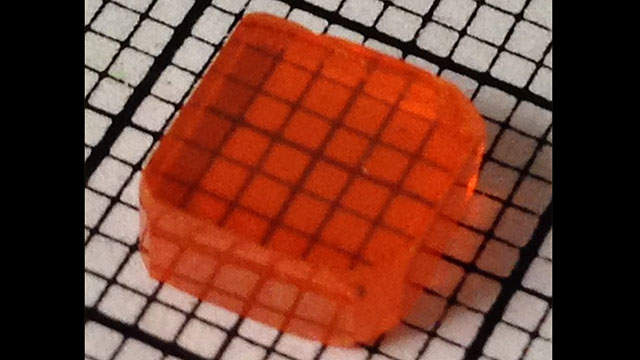
Researchers from Northwestern University and the Argonne National Laboratory have developed a high-performance material to be used in devices that detect gamma rays, which could provide an efficient and cost-effective means to detect nuclear radiation.
In the report, ‘High spectral resolution of gamma-rays at room temperature by perovskite CsPbBr3 single crystals’, published in the journal Nature Communications, the team describes an improved method of producing caesium lead bromide, and the design of a special detector equipped with an asymmetrical metal electrode configuration, which make the device more effective.
Go deeper with GlobalData


Discover B2B Marketing That Performs
Combine business intelligence and editorial excellence to reach engaged professionals across 36 leading media platforms.
“We achieved the same performance in two years of research and development as others did in 20 years with cadmium zinc telluride, the expensive material that is currently used,” said professor of chemistry at the university and corresponding author of the paper Mercouri G. Kanatzidis.
Argonne first noted the promise of caesium lead bromide in 2013, and since then researchers led by Kanatzidis have worked to purify and improve the material. A breakthrough came when Yihui He, a postdoctoral fellow in Kanatzidis’ group, reconfigured the semiconductor device in the material; instead of using the same electrode on either side of the crystal, he used two different electrodes, so the device only conducts electricity when gamma rays are present.
The device is capable of distinguishing different gamma ray-emitting materials from each other. Some materials are legal while others are illegal, and the detector was able to identify radioactive isotopes americium-241, caesium-137, cobalt-57 and sodium-22. The device could also detect cobalt-57 gamma rays as accurately as a cadmium zinc telluride detector.
“Governments of the world want a quick, low-cost way to detect gamma rays and nuclear radiation to fight terrorist activities, such as smuggling and dirty bombs, and the proliferation of nuclear materials,” said Kanatzidis.
“This has been a very difficult problem for scientists to solve. Now we have an exciting new semiconductor device that is inexpensive to make and works well at room temperature.”
The research was supported by the US Department of Energy, National Nuclear Security Administration, Office of Defense, Nuclear Nonproliferation Research and Development and the Department of Homeland Security ARI programme.


