
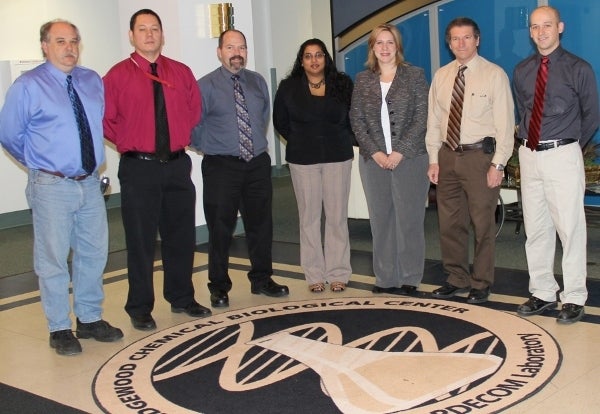
The Federal Laboratory Consortium for Technology Transfer (FLC) has recognised the work of the US Army Edgewood Chemical Biological Center (ECBC) on the development of a low-cost, Tactical-Biological Detector (TAC-BIO).
Go deeper with GlobalData


Discover B2B Marketing That Performs
Combine business intelligence and editorial excellence to reach engaged professionals across 36 leading media platforms.
Based on the Semiconductor Ultraviolet Optical Sources (SUVOS) technology, the biological agent sensor is designed to rapidly detect the presence of an airborne biological threat and provide an early warning to minimise exposure and casualties to the US Armed Forces.
The low-power device, developed through funding from the US Defense Advanced Research Projects Agency (DARPA), utilises the scientific principle of biological aerosols, which fluoresce and scatter light upon exposure to ultra violet (UV) light, to detect the existence of a threat.
Additional funding from the Defense Threat Reduction Agency (DTRA) helped the ECBC scientists and engineers to advance the design toward a mature, Technology Readiness Level 6 product.
The effort was also supported by the ECBC’s Chemical Biological Systems Integration team within its Research and Technology Directorate and the Advanced Design Manufacturing team within its Engineering Directorate.
The TAC-BIO programme resulted in five patents addressing advanced optics and optical interrogation techniques and also provides a biological agent detector that uses only 4% of the energy.
Most biological agent detectors prior to the TAC-BIO used large and costly UV lasers for extraction of optical signals from threat aerosols.
EDBC also signed a cooperative research and development agreement (CRADA) and a patent license agreement (PLA) with General Dynamics Armament and Technical Products (GDATP) for further development and commercialisation of the detector in November 2009.
According to EDBC, work is currently under progress to make the product simpler, more capable and durable in all weather conditions and potential licensees continue to be interested which will enable further modification of the TAC-BIO prior to its distribution and fielding with the Army.
Image: The Tactical-Biological Detector team at the US Army Edgewood Chemical Biological Center. Photo: ECBC.


