
The US Defense Advanced Research Projects Agency (DARPA) is seeking demonstrations of advanced technologies for the detection of improvised explosive devices (IEDs), as part of its methods of explosives detection at standoff (MEDS) programme.
During the proof-of-concept demonstrations, participants will be required to display non-contact methods and technologies for rapid and precise detection of bulk explosives embedded or packaged in mud, meat or animal carcasses.
Go deeper with GlobalData


Discover B2B Marketing That Performs
Combine business intelligence and editorial excellence to reach engaged professionals across 36 leading media platforms.
DARPA MEDS effort programme manager Dr Judah Goldwasser said the programme would represent a change for the agency’s past university performers, as it seeks proof-of-concept demonstrations of technologies and techniques, as opposed to only basic research.
"MEDS technologies may require new engineering and physics, Goldwasser said. "DARPA does not believe that incremental enhancements to existing imaging technologies will be adequate to meet the programme objectives.
"However, the building blocks for a solution are in place, as we’ve seen in several recent scientific breakthroughs."
To safeguard the operator’s health, the techniques will have to be developed without ionising radiations, and are required to detect, but not necessarily image the IEDs located at a depth of 5cm or more.
The research agency is encouraging universities, including the medical community, to collaborate with commercial industry for proposals, due to constraints on using radiations, and participants will also have to offer appropriate surrogates for explosives that will be used during testing.
MEDS period of performance is not expected to exceed 18 months, which includes a 12-month base period for research, development and capability demonstration, as well as a six-month option for follow-up reproduction and testing of successful capabilities at various US Government laboratories.
The proposed techniques will be evaluated on the anticipated trade-off between image fidelity and radiation output by DARPA to reduce IED threats to US troops.
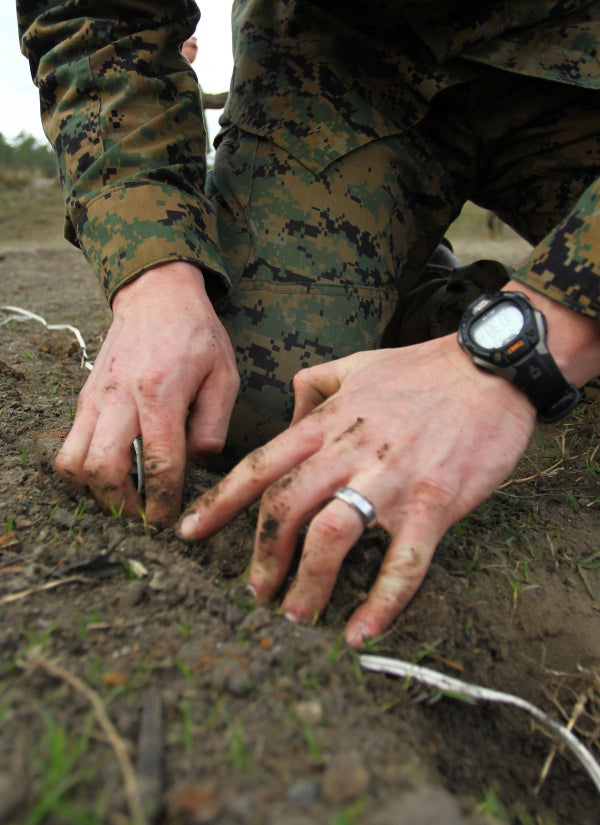
Image: A US Marine readies explosive materials for controlled detonation at EOD demolition range at Camp Lejeune in US. Photo: courtesy of DARPA.


