
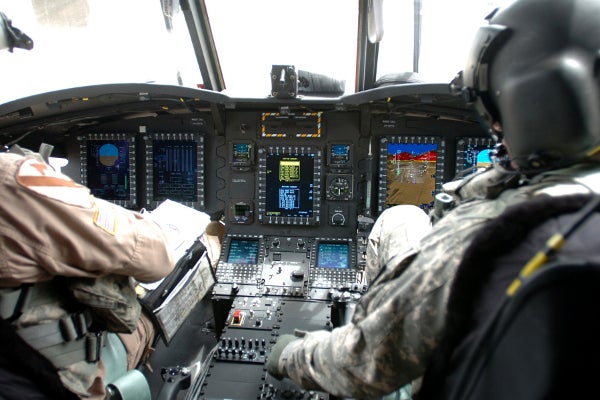
Rockwell Collins has been awarded a contract for development of a degraded visual environment pilotage system (DVEPS) for installation onboard the US Army’s Special Operations Aviation Regiment (SOAR) helicopters.
The contract covers work on the first of the three phased programme, which seeks to develop and qualify a DVE solution for fielding by 2018.
Go deeper with GlobalData


Discover B2B Marketing That Performs
Combine business intelligence and editorial excellence to reach engaged professionals across 36 leading media platforms.
Rockwell Collins airborne solutions vice-president and general manager, Troy Brunk, said the programme will provide the pilots with an ability to see through DVE obscurants, such as dust, fog, and snow and successfully avoid hazards in the landing zone.
”Our synthetic vision and sensor fusion technology will provide SOAR pilots with enhanced pilotage capabilities, resulting in safer operations and increased probability of mission success and aircraft survivability,” Brunk said.
”Our approach is to offer a scalable system that will allow affordable reuse by other DoD rotorcraft operators.”
Fully compatible with the army MH-47G and MH-60M helicopters’ existing common avionics architecture system, the DVEPS solution will allow safe flights in degraded visual environments and enhance visual cues to help pilots to maintain the correct attitude and speed during landing.
Fitted with Rockwell Collins’ synthetic vision avionics backbone (SVAB) system, the DVEPS solution also exhibits compliance with several other tactical helicopter avionics systems.
The SVAB system leverages advanced data processing algorithms to smartly fuse 3D synthetic vision-based imagery with lightweight DVE sensors, including millimetre wave radar or LIDAR.
The resulting fused 3D imagery is scheduled to be used in the DVEPS programme, along with improved pilotage symbology to provide pilots with an unprecedented view of the operational environment and flight guidance for enroute, approach and hover phases of flight.
The SVAB system has already completed demonstrations as part of the US Defense Advanced Research Projects Agency’s (DARPA) multi-function radio frequency (MFRF) programme.
Image: The DVEPS solution is fully compatible with the US Army’s MH-47G and MH-60M helicopters’ existing common avionics architecture system. Photo: copyright of Rockwell Collins.



