
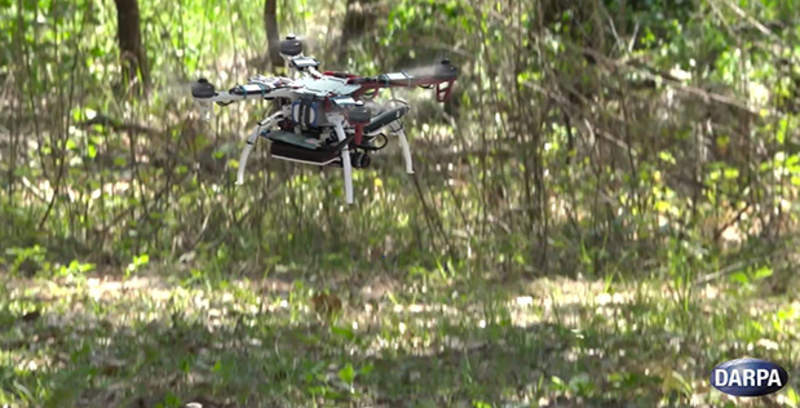

The US Defense Advanced Research Projects Agency (DARPA) has conducted tests on small unmanned quadcopters, marking the completion of Phase I of its fast lightweight autonomy (FLA) programme.
The FLA programme seeks to develop small autonomous unmanned aerial vehicles (UAVs) that can fly at speeds up to 20m/s without the guidance of a human operator and GPS waypoints.
Go deeper with GlobalData


Discover B2B Marketing That Performs
Combine business intelligence and editorial excellence to reach engaged professionals across 36 leading media platforms.
As part of the programme, three research teams from DARPA flew small unmanned quadcopters through cluttered buildings and obstacle-strewn environments using onboard cameras, sensors and smart algorithms that enable self-navigation.
DARPA FLA programme manager JC Ledé said: “The goal of FLA is to develop advanced algorithms to allow unmanned air or ground vehicles to operate without the guidance of a human teleoperator, GPS, or any data links going to or coming from the vehicle.
“Small, low-cost unmanned aircraft rely heavily on teleoperators and GPS not only for knowing the vehicle’s position precisely, but also for correcting errors in the estimated altitude and velocity of the air vehicle, without which the vehicle wouldn’t know for very long if it’s flying straight and level or in a steep turn.
“In FLA, the aircraft has to figure all of that out on its own with sufficient accuracy to avoid obstacles and complete its mission.”

US Tariffs are shifting - will you react or anticipate?
Don’t let policy changes catch you off guard. Stay proactive with real-time data and expert analysis.
By GlobalDataThe quadcopters can be used to scan for threats inside a building safely and quickly before military teams enter.
The technology can also be used to locate downed pilots in heavily forested areas, where overhead imagery cannot see through the tree canopy, or survivors following earthquakes or other disasters, when entering a damaged structure could be unsafe.
Image: Three research teams from DARPA flew small unmanned quadcopters through cluttered buildings and obstacle-strewn environments. Photo: courtesy of the Defense Advanced Research Projects Agency.



